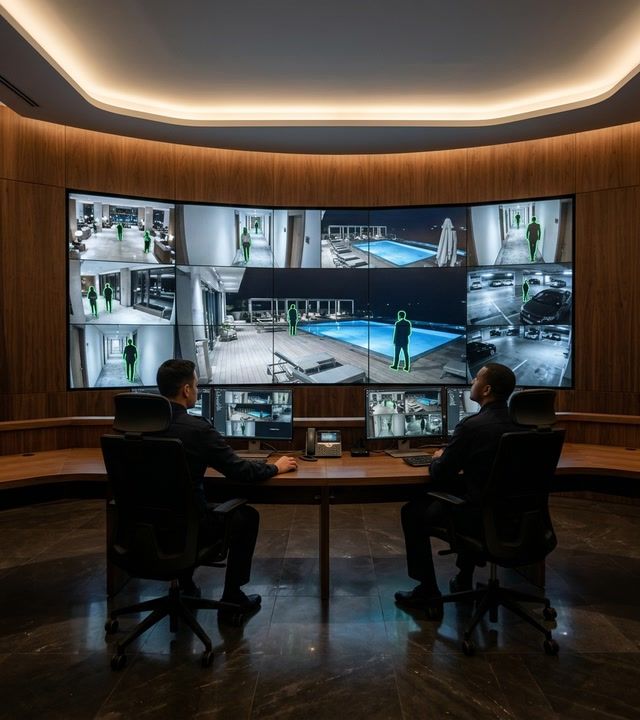
Every model is attacked, fixed and judged by our AI agents before it reaches your control room, and your team signs off each change. Built for guest safety: no faces used, and a person decides every action.
Pictures on this site are generated.
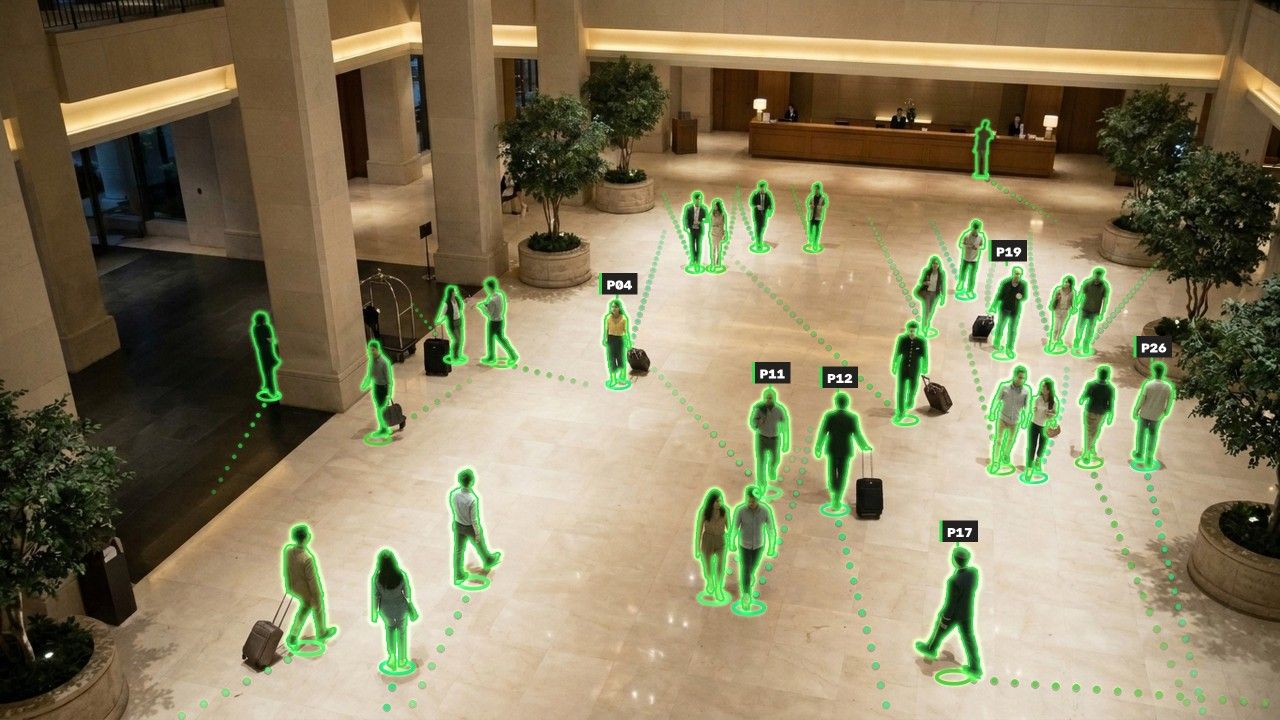
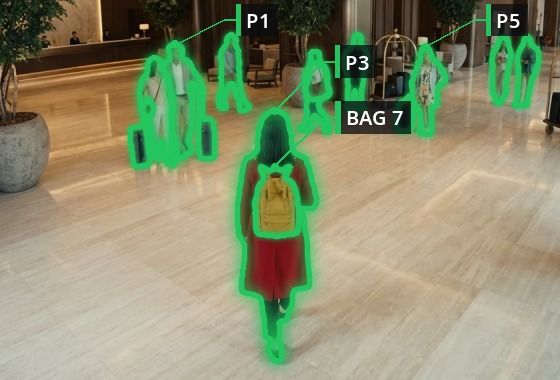
Cameras placed on a 3D model built from your floor plans, ending where the person was last seen.
Describe a person or a behaviour and see every camera where it appears, in time order.
Each place learns its own normal by half hour; every alert says in words what is different.
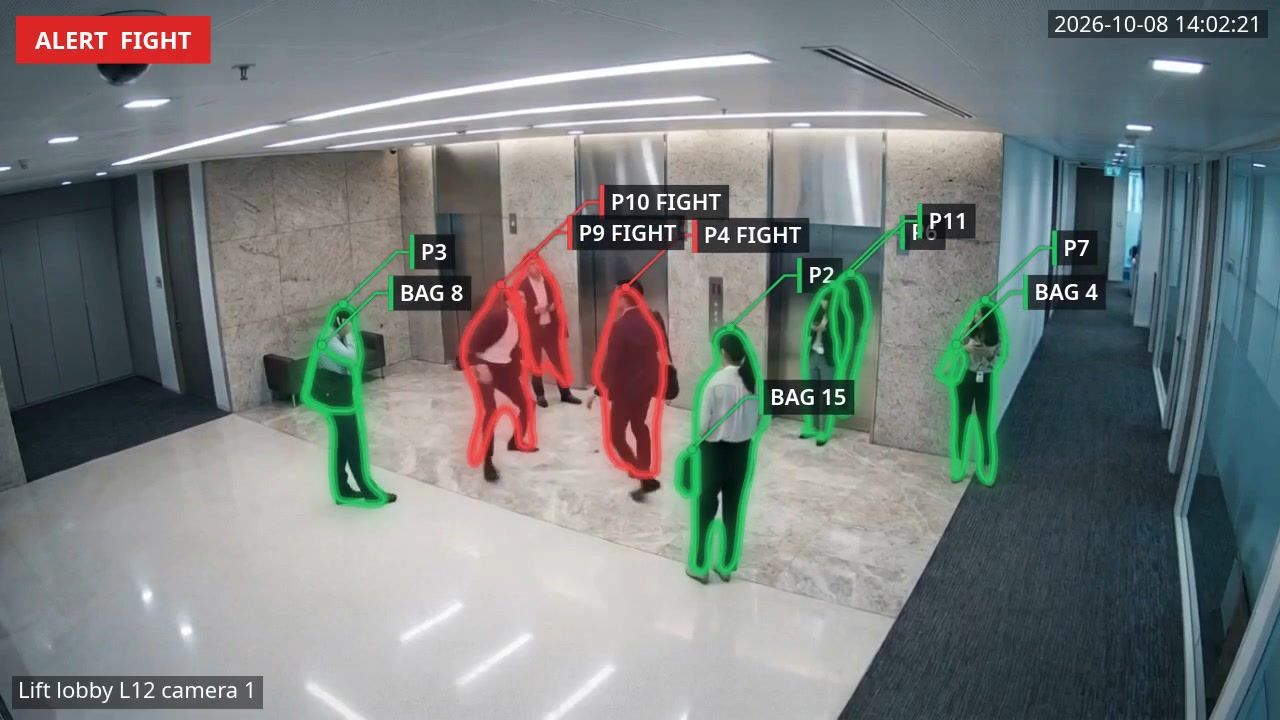
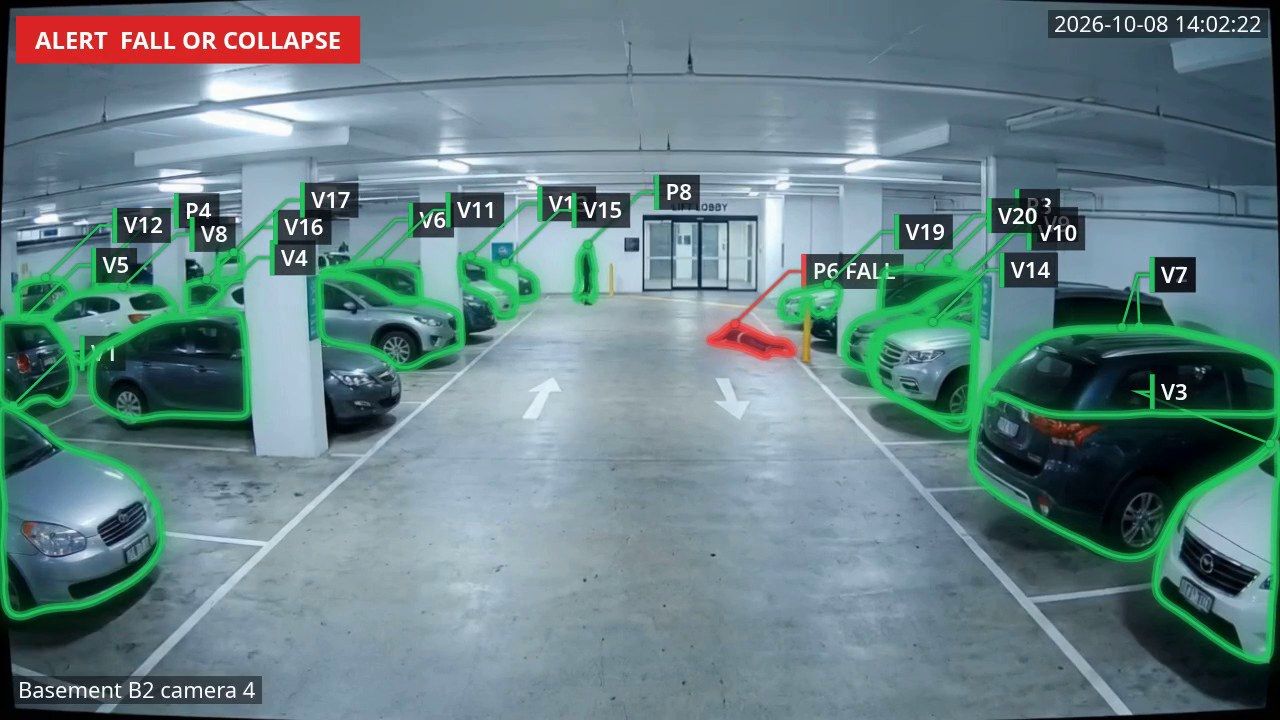
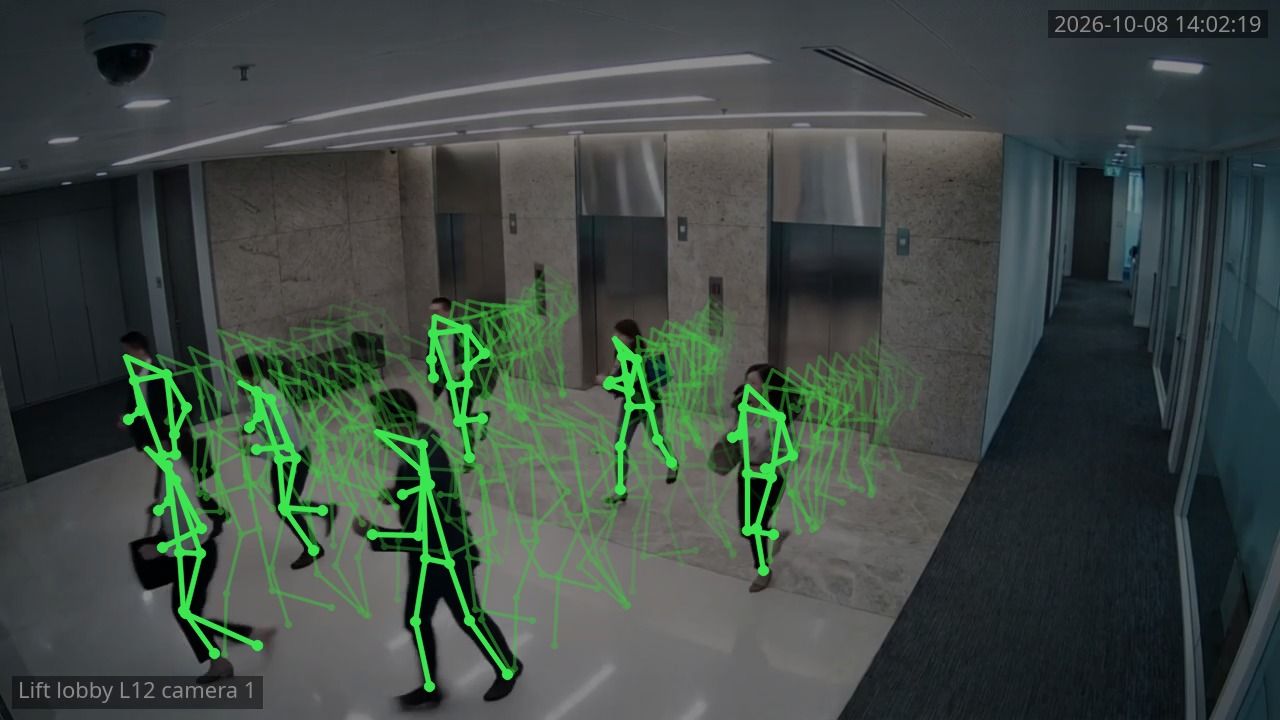
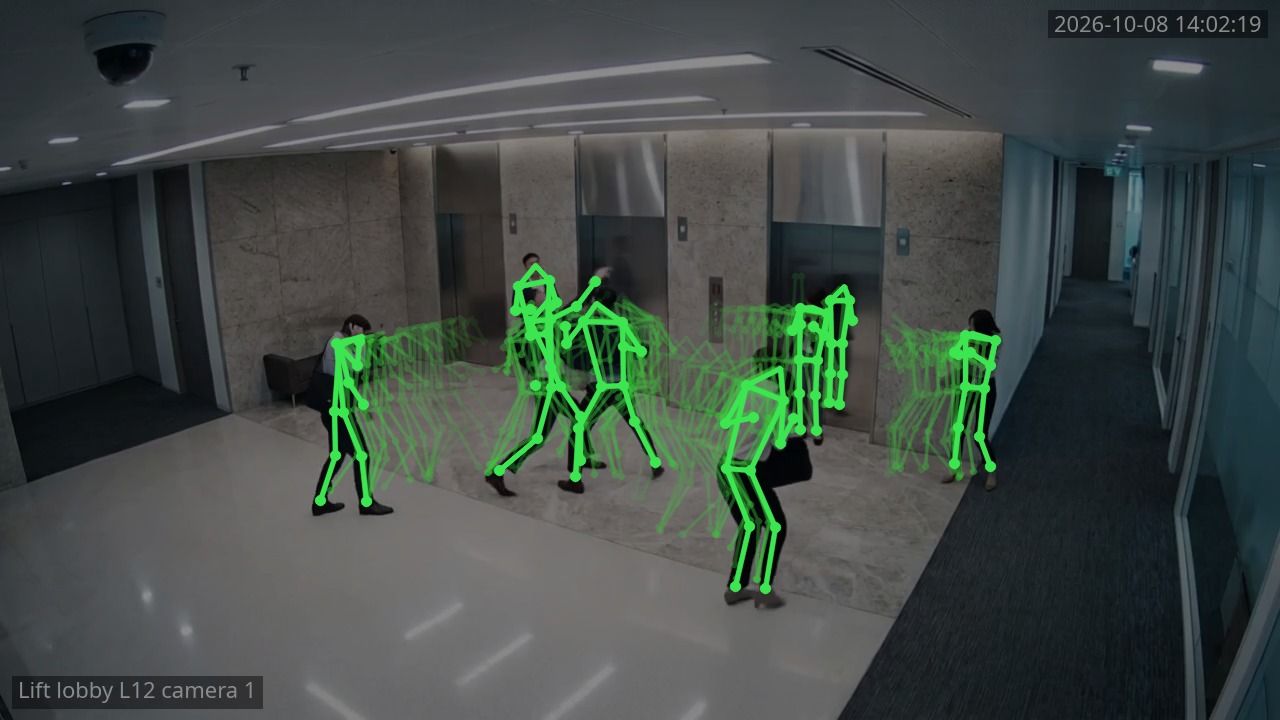
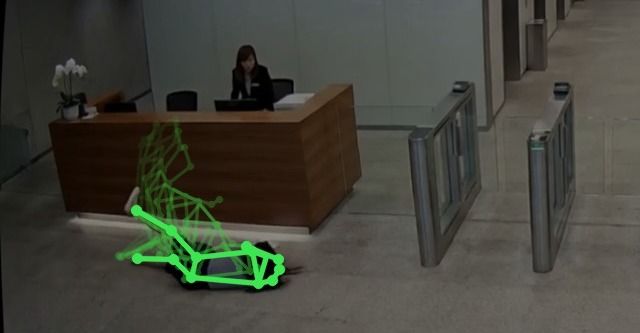
Fights, falls and running read from how each body moves, frame by frame.
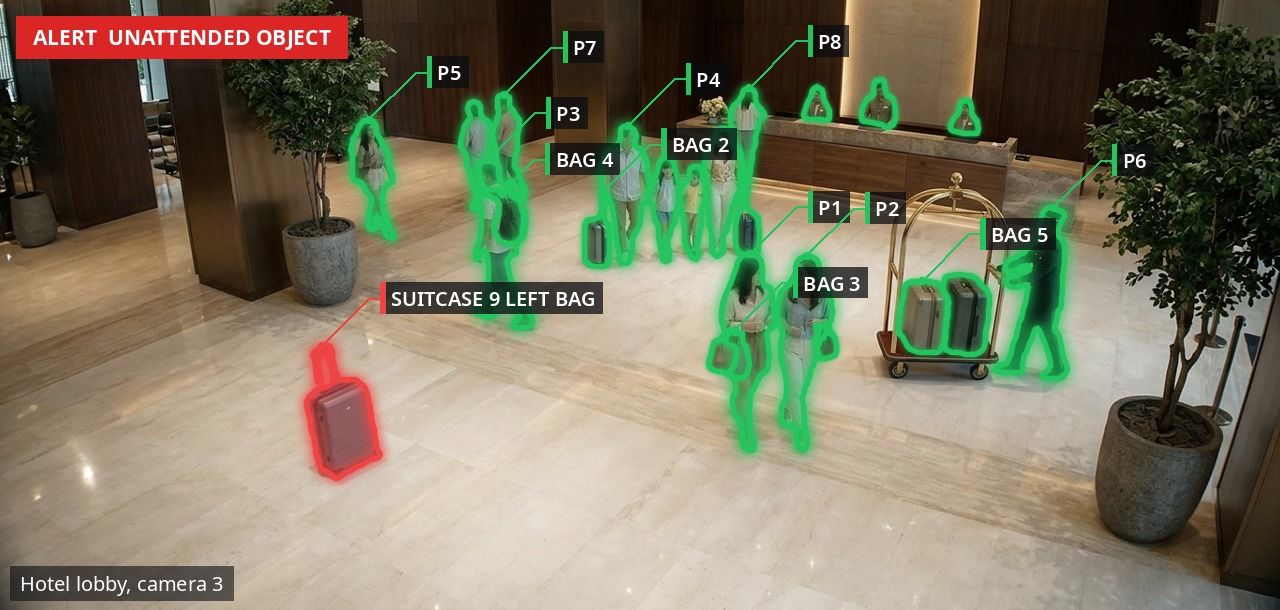
Weapons, left bags, site objects and furniture, trained by our own team.
Agent teams test, judge and govern a fleet of models; red, amber and green cuts per detection type.
A companion reports someone missing. Today that can mean minutes of replay across many cameras.
Describe them in plain words; every sighting comes back in time order, ending at last seen.
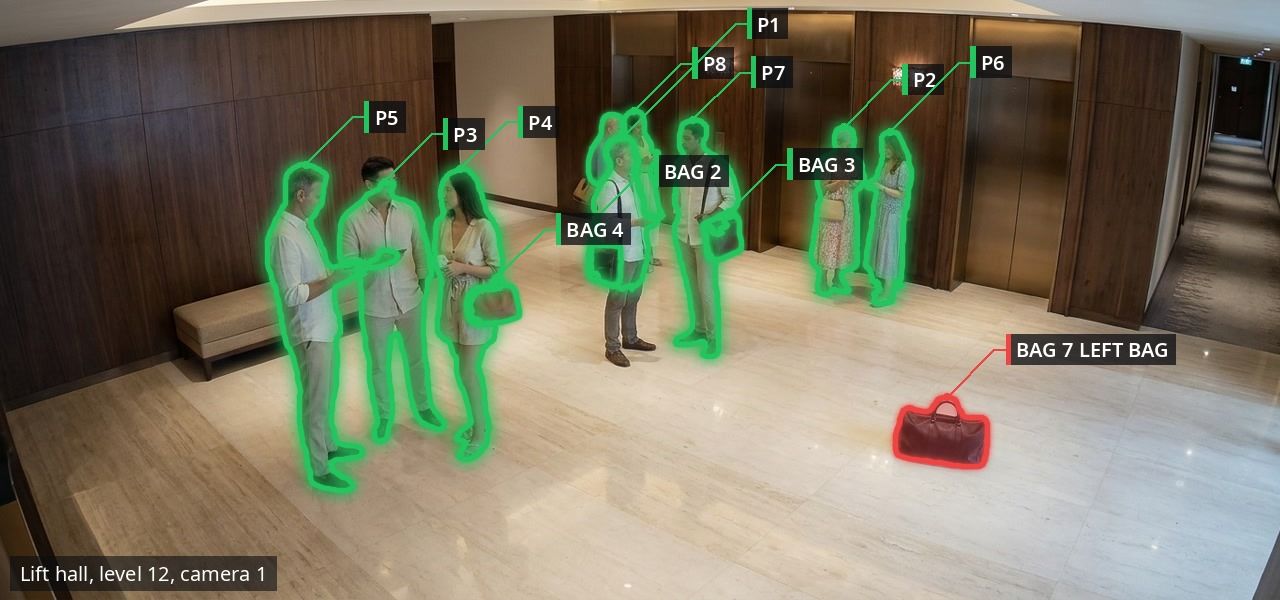
A bag sits by a lift hall. Operators may not see it among hundreds of feeds.
An alert with the clip of the person who left it; a person decides what happens next.
Loading bays and corridors are quiet, so unusual activity is easy to miss.
Each area learns its own normal by half hour; an alert says in words what is different.
Our expectations, not your figures: your team sets the real tasks and measures before the test.
each model promoted on its own ruling
Every model change is tested, judged, approved by your named owner, logged and reversible.
Our own object classes on top of a broad model, so weapons, trolleys and left bags are first-class objects.
Every model is scored, event by event, on images it never trained on, before it raises a single alert.
We build whole synthetic places to rehearse fights, falls and left bags that real footage seldom shows.
Detector, pose, tracker, re-identification and vision-language models work together; a doubtful detection needs a second model to agree.
Agents retrain, test and judge a new model each round; operator answers become new examples.
No face matching. Footage, the sighting record and every model stay on servers you control.
| MEASURED CUTS PER DETECTION TYPE | ABOVE RED CUT | PRECISION | Found in red or amber |
|---|---|---|---|
| Luggage | 0.75 | 1.00 | 91% |
| Large rucksack | 0.75 | 1.00 | 96% |
| Queue pole | 0.85 | 1.00 | 100% |
| Tower container | 0.85 | 1.00 | 100% |
| Machete | 0.70 | 1.00 | 97% |
| Katana | 0.65 | 0.90 | 87% |
Cuts and precision come from the same held-out images, August 2025, so every red cut is re-checked on your footage. A selection of tuned classes; site objects such as queue poles alert only if your team chooses.
A model that already knows everyday objects learns our security classes without forgetting them.
25 training runs; each starts from the kept model and replaces it only if it scores higher.
Red and amber cuts are set per class, so each alert type is tuned on its own score curve.
Amber detections go to a vision-language model before a person, which lifts precision again.
Source: our detector training records and per-class threshold file, July to September 2025, measured on held-out images. mAP50, found and precision are different measures.
Examples from our detectors' training configurations.
| Capability | Motion-only analytics | Reluvate and SquirrelSentry |
|---|---|---|
| Learns what is normal | Per camera, from movement | Per place and hour, from people and objects |
| Knows who and what is in view | Movement only | 113 object classes, people and what they carry |
| Same person across cameras | Each camera on its own | Matched on clothing and build; match rate scored in your test |
| Says why, in words | Something unusual happened here | What, where, who, and how it differs |
| Plain-English search | Not part of motion analytics | Descriptions, behaviours and places |
| A new need, trained for you | Fixed to motion | Trained on your footage, measured before it alerts |
| Accuracy you can check | Described across deployments | F1 per event, on your own footage |
Left column: motion-only analytics. Many video platforms now add appearance or text search of their own.
Illustrative model; on site it is built from your floor plans.
Same description found on 2 cameras, in time order, from 1,686 sightings searched in 66 ms


Lift hall, level 12, camera 1. Seen 39 seconds earlier at the lobby entrance. Every sighting opens its clip.
Behaviours are in the same record, so "any fights?" or "person lying on the floor" returns the camera, the time and the clip.
Illustrative. Normal ranges are learned from your own footage for each area, hour and weekday.

113 classes, 33 of them trained by us

F1 of 1.00 at a public transport operator

F1 of 0.96 on our fight test clips

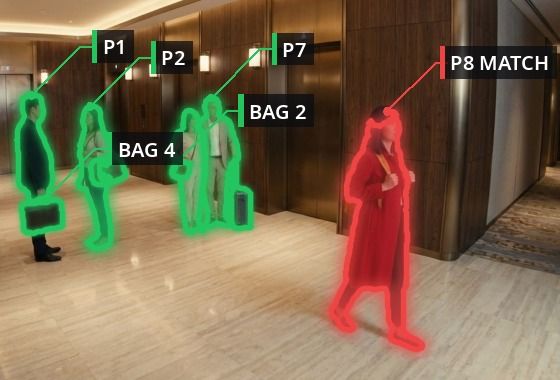
Raised with the clip, where a camera sees them

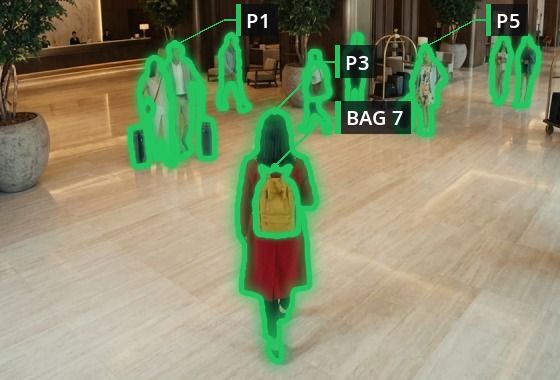
Matched by clothing and build, never by face

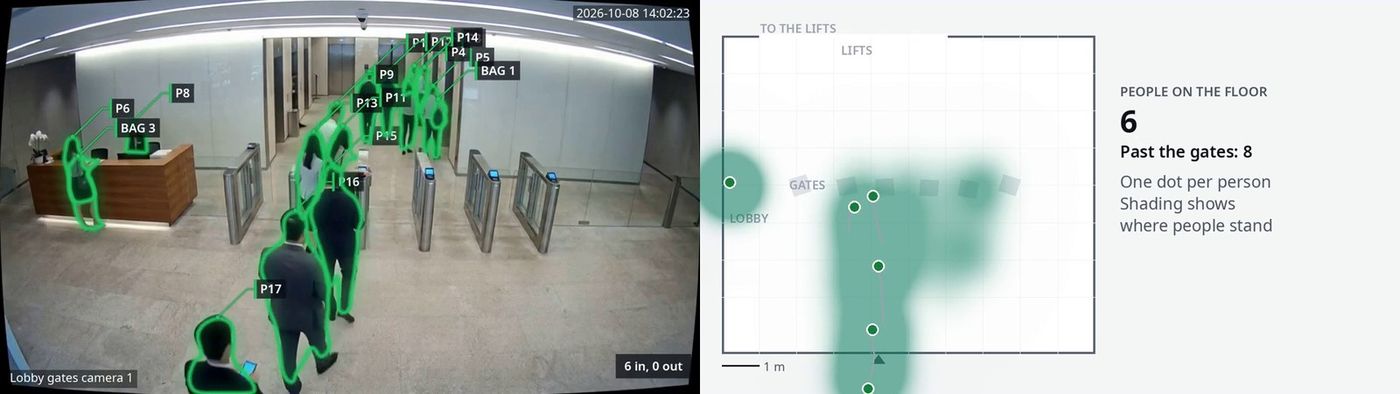
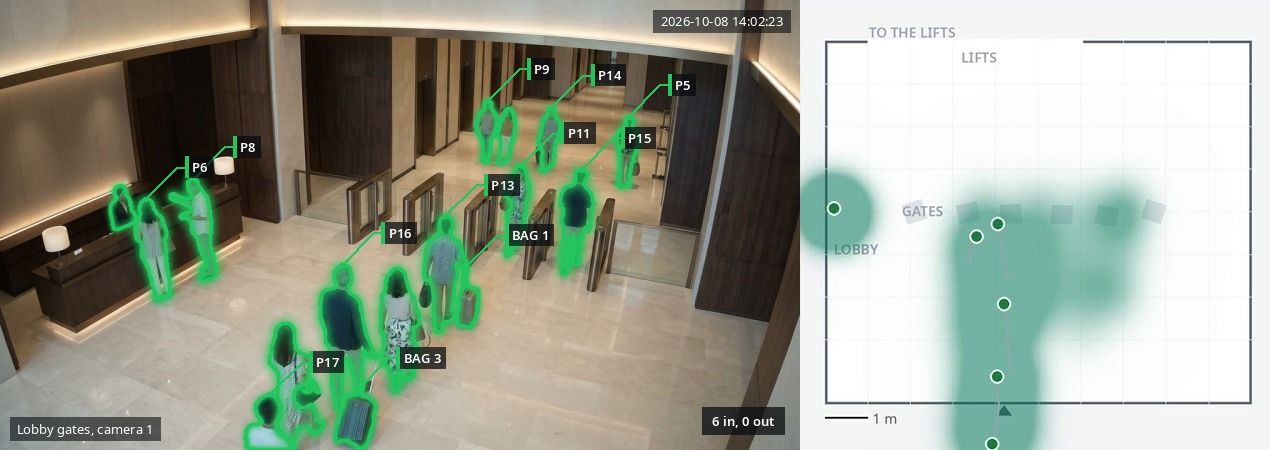
People placed in metres on your plan

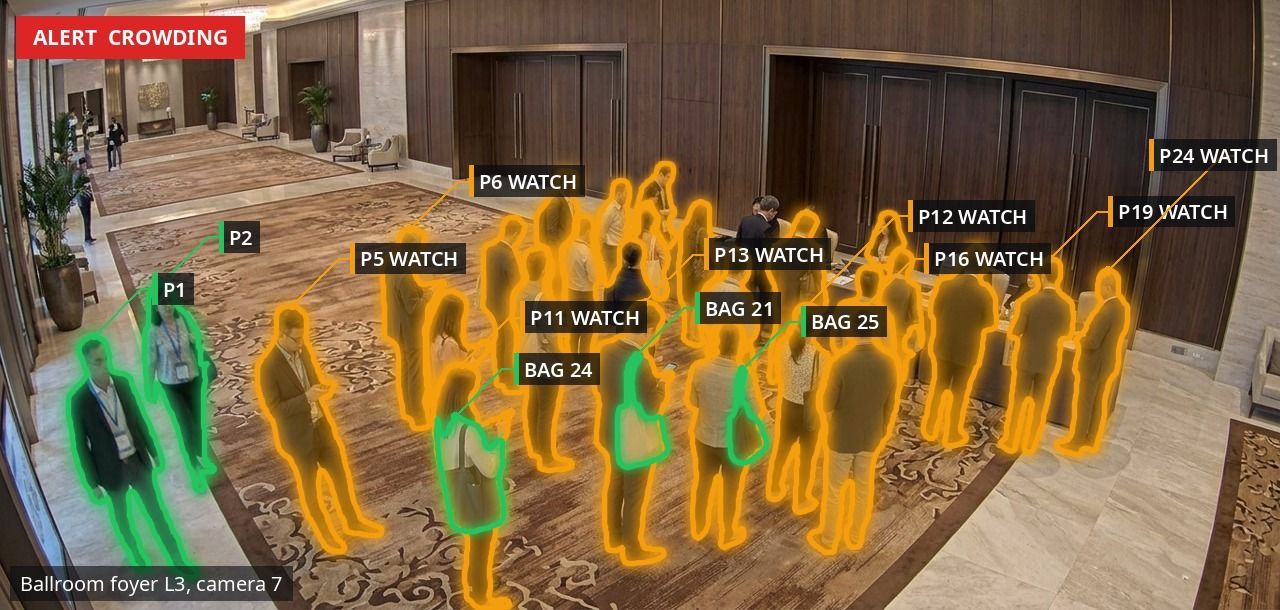
Counted per zone against the limit you set

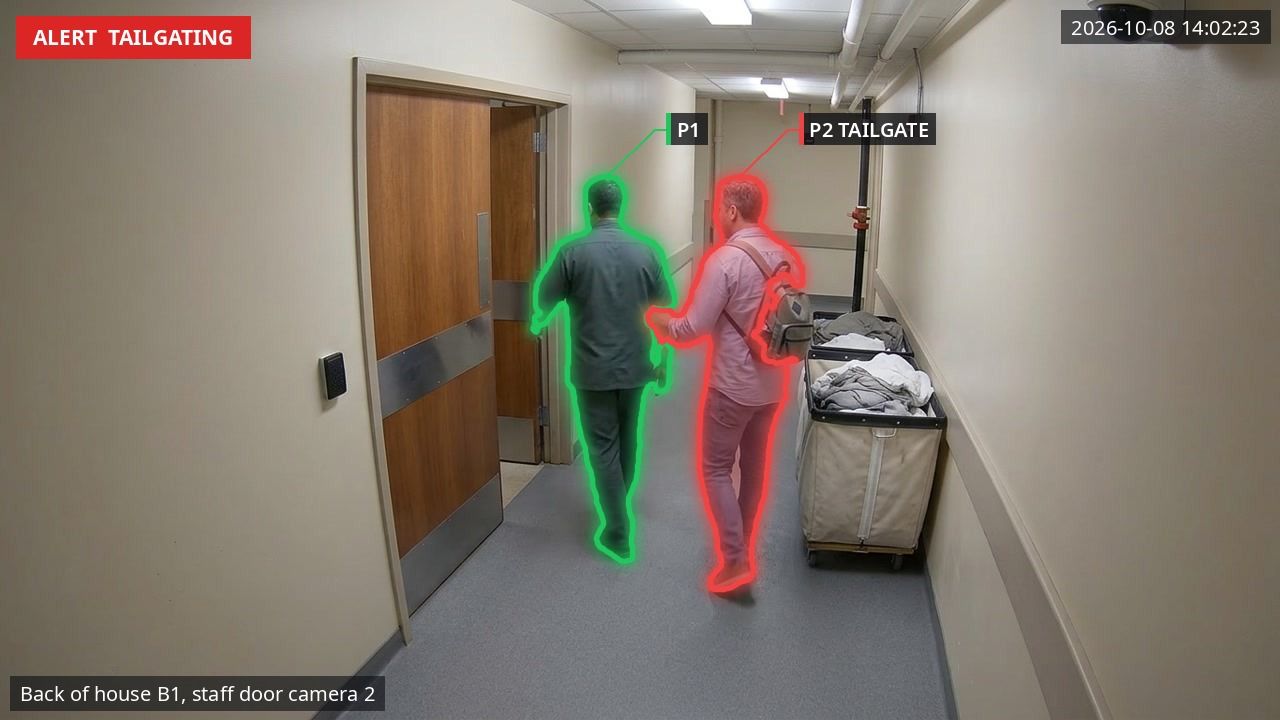
Two people through one entry

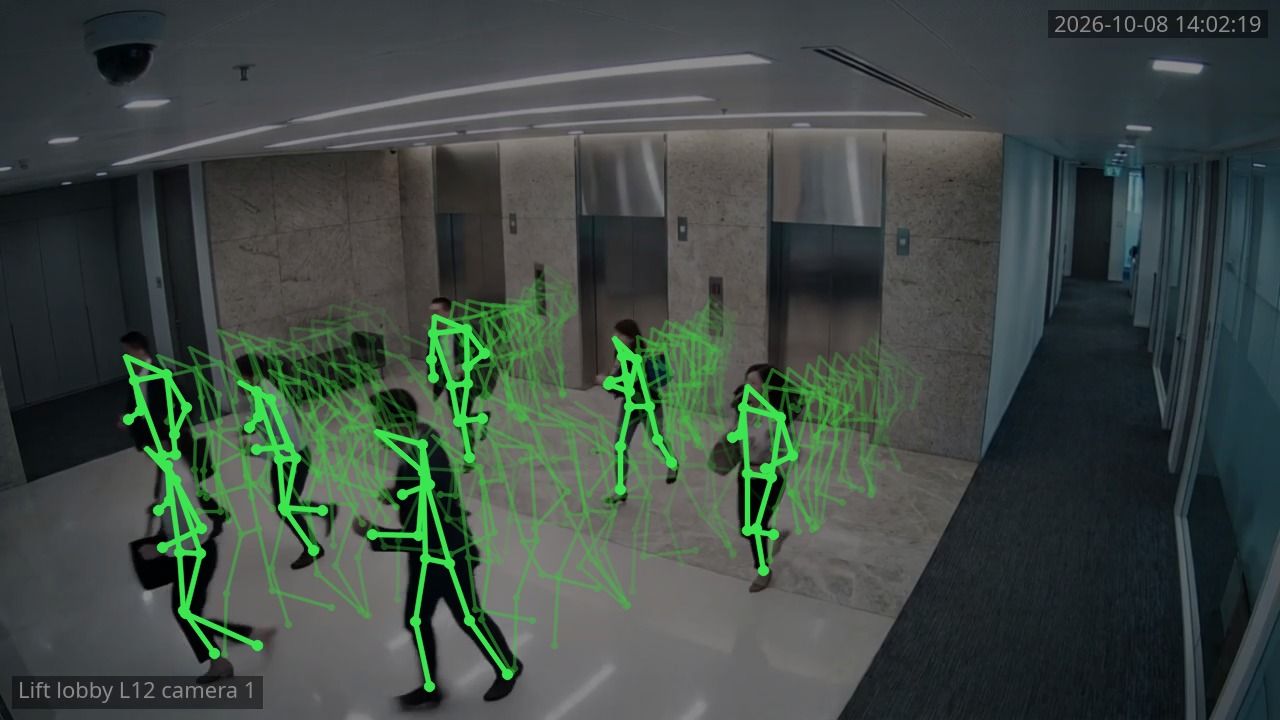
Speed and direction read from body pose

Told apart, with where people stand
Results measured on each project's test set. All images from generated footage. Clients are described by industry.


Each person followed frame by frame inside one view
Clothing, build and colours; faces are not needed
Weighted by how long since the last sighting
Sightings placed in metres, so a path crosses floors

F1 at a public transport operator, over 105,057 station frames, 2025
Not yet shown: a hotel, a mall or a convention hall
across 160 minutes of a real building lobby's footage, every bag found
Not yet shown: crowded halls at peak hours
queue poles, luggage and spears, on images never trained on
Not yet shown: your cameras, angles and lighting
| F1 | PRECISION | RECALL | |
|---|---|---|---|
| RAIL STATION EVENTS, CLIENT FOOTAGE | |||
| Unattended object | 1.00 | 1.00 | 1.00 |
| Gantry climb | 1.00 | 1.00 | 1.00 |
| Oversized object | 0.82 | 0.70 | 1.00 |
| Weapon | 0.80 | 0.67 | 1.00 |
| OUR OWN CLASSES, HELD-OUT IMAGES | |||
| Queue pole | 0.93 | 1.00 | 0.87 |
| Luggage | 0.90 | 0.92 | 0.88 |
| Spear | 0.86 | 0.80 | 0.94 |
F1 1.00 means no false alert and no miss. Transport figures were scored before per-class cuts, so one weapon alert in three was false; weapon cuts now come from held-out images and are re-checked on your footage.
Station cameras detect left objects and gantry climbs at an F1 of 1.00, and weapons and oversized objects at 0.80 to 0.82
Very high-resolution frames from 7 cameras on a limited GPU budget. Posters, standees and queue poles that resemble weapons. Left items as small as a tennis ball in busy concourses.
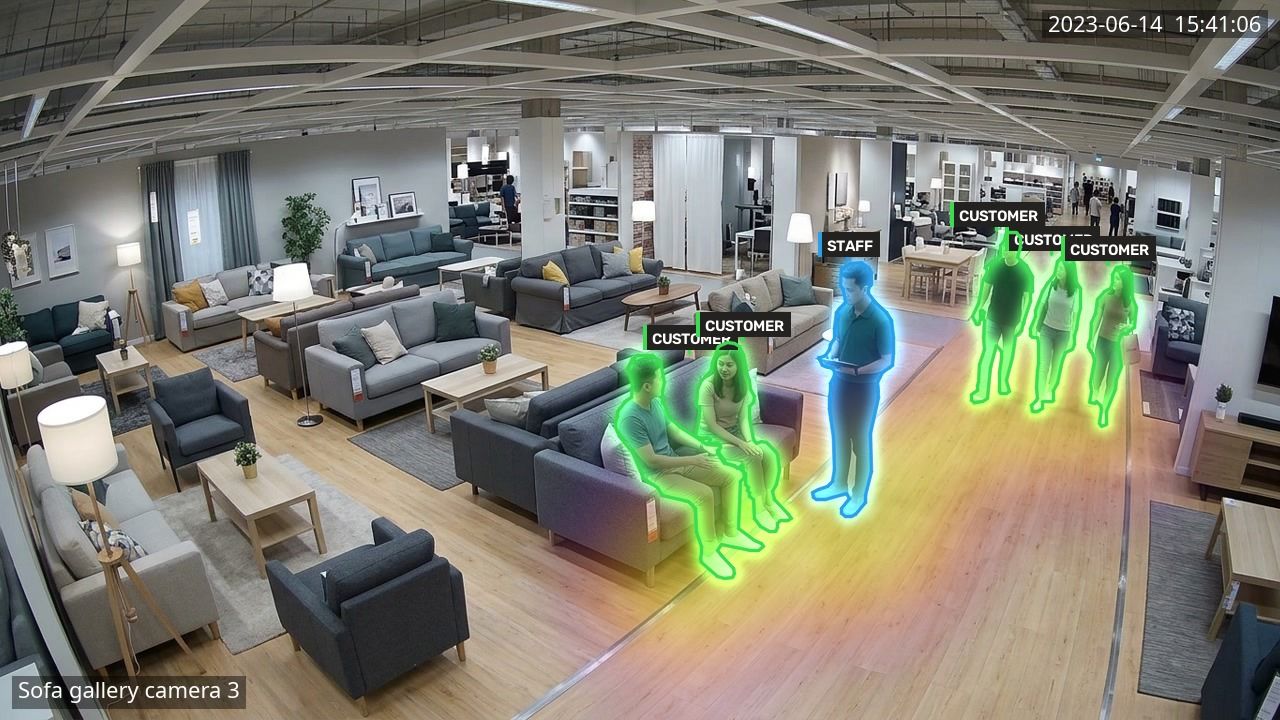
Showroom cameras show where shoppers walk, stop and engage with products, so merchandising decisions rest on measured behaviour
Wide showroom cameras full of sofas, mirrors and displays. Telling staff from shoppers. Knowing which displays draw people in and which they walk past.
Images from generated footage; the client's cameras are not shown.
Everything inside your property
Footage on site, search in your cloud
GPU servers in your own account
On premises, every part runs inside your property and works with no internet connection
In the hybrid option, footage stays on site and only sighting records and thumbnails go to your own cloud
In your private cloud, the GPU servers run in your own account and nothing is open to the internet
Which detections run on which cameras
How fast an alert must reach the control room
How many frames a second each use case needs
A left bag costs less to check than a fight
Every use case your cameras run today, with its frame rate and GPU load.
Use cases run faster or on more GPUs than their response time needs.
What your current use cases could run on, use case by use case, before anything changes.
The scan reads your current setup and changes nothing. The recommendation is yours to act on, with or without us.
No GPU count is quoted before your use cases, response times and cameras are known.
Control rooms, phones, alerts out
Detection, pose, tracking, matching
Run on servers you control
Only with your written approval; never footage, images or sighting records
Services, queues, the sighting record
On premises or your cloud; rented GPUs only for our synthetic training
A named data protection officer; retention and purpose set with yours.
Eight policies, from incident response to cross-border safeguards.
Read-only streams. No footage, image or sighting record ever goes to a hosted model or rented GPU.
Matching by clothing and build, never by face; faces can be blurred.
Recordings and the sighting record deleted on your schedule.
Production access limited to named, approved staff, every action logged.
Alerts go to an operator; nothing is acted on without one.
A new detector runs alongside the current one until it scores better.
55+ subverticals served; 65 AI technologies built in house
Singapore head office, Kuala Lumpur and Osaka
On request; released to you only if we stop supporting the system
Your footage and sighting records deleted on exit, with a signed record
| Measure | How it is scored | Our figure so far | Your pass mark |
|---|---|---|---|
| Left bags found | Use footage with a known left bag, or place one for the test; bags found against bags marked | Every bag found, zero false alarms, over 160 minutes of a building lobby | Set by your team |
| False alerts per camera per hour | Alerts your operators mark as wrong, divided by cameras and hours | First measured in this test | Set by your team |
| Minutes to find a described person | From a plain-word description to the last-seen camera, against your replay today | First measured in this test; the search itself took 66 ms on our generated footage | Set by your team |
| Cross-camera match rate | Sightings of one person correctly joined across cameras, and wrong joins, on people your team labels | First measured in this test | Set by your team |
| Back-of-house alerts worth acting on | Alerts your operators mark as needing action; learned normal ranges need weeks of footage, so they start in the first phase | First measured in this test | Set by your team |
Our figures so far come from other sites, held-out images and generated footage. Only your footage and your pass marks decide.

To pick the cameras, footage or live, and write a pass mark for each measure on the test plan.
From areas your team picks, after an NDA and data agreement: your team sends recorded footage, or gives us a camera's IP address for a read-only live stream. Footage is deleted afterwards with a signed record.
Each measure scored against your pass mark, including any it misses.
Cameras, use cases and timeline set from the test results, with decision points agreed with your team and data deleted on exit; priced when your team is ready to discuss it.
No commitment for the conversation or the test.